

 Chaardham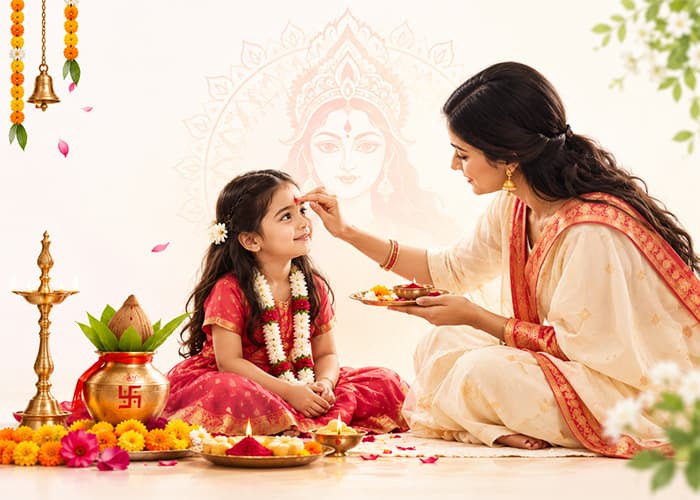
Do you remember, as a girl, being welcomed into a neighbour's home during Navratri? Your feet washed, a tilak placed on your forehead, bombarded with gifts, and called Devi before you had even eaten breakfast?
For Indian women, that moment stays engraved in their memories forever. Navratri is one of the widely celebrated festivals in Hinduism. It lasts nine nights, dedicated to Shakti. The feminine energy.
Navratri does not stop at music festivals, melas, fasting, or temples. Homes across India open their doors, and young girls are invited in, whom they see as a mirror image of goddesses. They are fed food, given gifts, and treated with deep love and respect. This ritual of worshipping the girl as a living form of the Goddess is called Kanya Pujan.
You could definitely think that it might be a tradition.
If so, you need to ponder over it again…
It’s rather about feeling the energies and divinities in their purest form rather than feeling them in the statues, stones, or idols.
The next question that might pop into your mind is, "Why does devotion to Maa Durga lead people to see a young girl as an incarnation of the goddess?"
That’s an absolutely valid question.
Because at this time, people believe that the goddess is not only resting at the temple but has taken the human form of a young maiden. And the goddess visits their home in the form of that young maiden.
The way we once were the Devi, now we invite other young girls to be her too. In doing so, we keep the spirit of Navratri alive. Not only through prayers but through acts of kindness, care, and love.
What Is Kanya Pujan?
You might have definitely heard from your mom that Kanya Pujan is coming; she needs to buy gifts for the young girls. That’s what Kanya Pujan is, if explained in simple words. Kanya Pujan, also known as Kanjak Puja, is a widely celebrated ritual in North India, where young girls are worshipped. It is usually done twice a year, but it is performed during Navratri and in the months of March or April, and is of great significance.
Is seen as a week of worship entirely and deeply dedicated to Maa Durga and her forms. The word ‘Kanya’ means ‘girl or maiden’, and ‘Puja’ means ‘worship’. Rather than keeping this divine presence only within idols or temples, the belief encourages people to see and honor that same energy in a young girl child.
Why Is Kanya Pujan Significant During Navratri?
It would be easy to say girls represent Maa Durga and stop there. The tradition asks for something deeper. Navratri begins with calling Shakti using a kalash and an idol. That act is rooted in faith and ritual.
Kanya Pujan moves devotion from worship to seva. A young girl carries qualities that Hindu thought has long linked to the Goddess. Those qualities include innocence, purity, and an energy that is not yet shaped by the world. Feeding the girl, washing the girl’s feet, and seeking the girl's blessings becomes a way of practising humility and gratitude. In families, this moment of Navratri stops being only about personal fasting and becomes about respecting young girls.
When Is Kanya Pujan Performed?
You might be wondering when Kanya Pujan is usually performed. Let us unravel that for you. It is commonly performed on Ashtami or Navami, the eighth or ninth day of Navratri, though customs are based on families and region. Kanya Pujan is performed twice a year: Chaitra Navratri (Spring) and Sharad Navratri (Autumn).
This year, Sharad Navratri 2026 begins on Sunday, 11 October, and continues through Monday, 19 October. Both Durga Ashtami and Maha Navami fall on the same day, i.e., 19 October.
How to Perform Kanya Pujan at Home
Begin by waking up early and taking a bath, followed by cleaning the puja space and preparing the prasad in advance. Invite young girls to your house. Before the girls enter your house, wash their feet, then apply a tilak on the girls' foreheads.
In some households, a young boy is also invited alongside the girls to represent Bhairav. Once seated, the girls are served with prashad. Afterwards, the girls are offered dakshina or a small gift, as a token of respect, along with a heartfelt request for their blessings.
The puja usually ends with a prayer to Maa Durga, thanking Maa Durga for her presence through the nine days.
Kanya Pujan Rituals and Traditional Offerings
The food served during Kanya Pujan includes halwa, puri, and kala chana. Sometimes there are fruits and sweets as well to accompany the prashad. The food is first offered to Goddess Durga with devotion, then offered to young girls, followed by other members of the family. Alongside the meal, girls usually receive dakshina or a small gift.
Navratri 2026: 9 Days of Devotion and Forms of Maa Durga
Day | Date (2026) | Maa Durga's Roop | Significance | Practices Followed |
1 | 11 October, Sunday | Maa Shailputri | Daughter of the mountain, represents spiritual growth, peace, and stability | Kalash sthapana, prayers, fasting begins, reciting mantras |
2 | 12 October, Monday | Maa Brahmacharini | Represents discipline and devotion | Japa, meditation, simple vrat food, reciting mantras |
3 | 13 October, Tuesday | Maa Chandraghanta | Symbol of courage and grace | Puja, temple visit, aarti |
4 | 14 October, Wednesday | Maa Kushmanda | Believed to have created the universe with her smile | Puja, temple visit, aarti, offer pumpkin seeds to the goddess |
5 | 15 October, Thursday | Maa Skanda | Mother of Skanda, representing maternal strength, wisdom, spiritual growth | Family puja, seva |
6 | 16 October, Friday | Maa Katyayani | Warrior form, associated with strength against adversity | Special puja, mantra chanting |
7 | 17-18 October, Saturday/Sunday | Maa Kalratri | Fierce protector form, dispeller of fear and darkness | Night prayers, continued fasting |
8 | 19 October, Monday | Maa Maha Gauri | Represents purity and peace after penance | Kanya Pujan, Ashtami puja |
9 | 19 October, Monday | Maa Siddhidatri | Bestower of spiritual accomplishment, final form worshipped | Kanya Pujan, Navami havan, concluding prayers |
Because Ashtami and Navami fall so close together in 2026, many families choose to perform Kanya Pujan on the same day, though some prefer to spread it across both. Dussehra follows on 20 October, marking the end of the festival with Durga visarjan in several regions.
The Spiritual Meaning Behind Kanya Pujan
Kanya Pujan is not only about a ritual that devotees follow, but it is deeply rooted in spirituality. It motivates people to bring their belief outside the place where they pray and put it for a short time in front of a child who has done nothing to deserve it except to be innocent and full of promise. This might be the change that the tradition brings.
It also asks devotees to surrender their ego when they wash the feet of young maidens, and not only that, it brings in spiritual cleansing when the devotees keep fast.
Conclusion
Navratri is more than lights, music, garba nights, and its temple crowds, but it has a deeper meaning aligned with it. It asks devotees to reflect on their actions, turn inward, and let that devotion shape how they treat the people around them.
Kanya Pujan beautifully captures the essence of celebrating Shakti associated with the young girls who are seen as the form of the goddess. The celebration inculcates the offering of food to young girls, feet washed with care, and blessings taken from young girls who, for that one day, are seen as Maa Durga.
Devotees who want to walk the path of devotion find that places like Chaar Dham Vrindavan and the home of Maa Vaishno Devi Dham are a must-visit. And feel the Shakti energies firsthand. It is beautifully engraved in the idea that Shakti is never away from you.