

 Chaardham
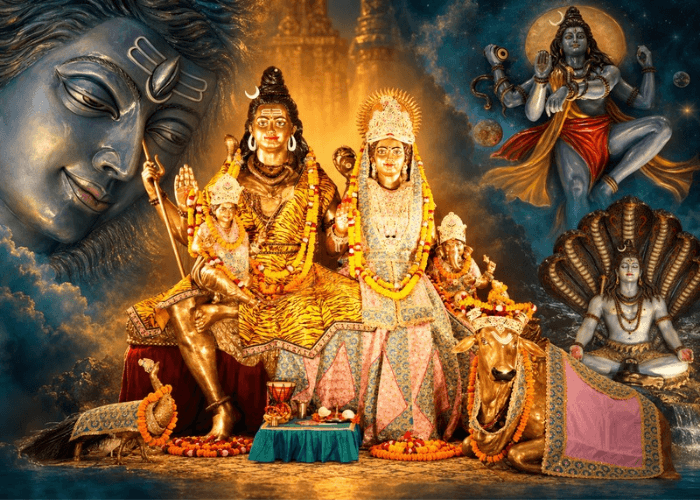
A Shiva idol often catches our attention in the temple. There is something deeply calming about his presence, as if he has found peace with everything we are still trying to understand in life. His calmness reflects patience, strength, and acceptance.
Yet, Shiva is also seen as Nataraja, the cosmic dancer, whose dance represents both creation and destruction. He beautifully brings together stillness and movement, reminding us that life is a balance of change and peace.
This beautiful contrast comes alive at Shiv Dham, Chaar Dham Temple, Vrindavan, where visitors can experience the many dimensions of Lord Shiva.
The Significance of Lord Shiva at Shiv Dham
Shiv Dham is the sacred home of Mahadev, the greatest of all the Gods, and as one of the principal deities of Hinduism, associated within the Trimurti with destruction and transformation alongside Brahma and Vishnu, but the temple does not stop at that single description.
The complex builds an entire visual language around him: the serpent Vasuki at his neck, the crescent moon in his hair, the Ganga flowing from his tangled hair, the third eye of insight, and the Damru in his hand. Each symbol is a reminder that Shiva's significance lies in holding opposites together.
He is fierce enough to be called Rudra and gentle enough to be called Shankara, the bringer of peace. Shiv Dham was built to let a visitor walk through all his forms, rather than encounter only one side of it.
The Deeper Meaning of Shiva’s Distinct Representations
You would be shocked to know that in Hinduism, idols are often used to communicate philosophy rather than simply history. A single image cannot capture every aspect of a being described as both consciousness and deeply personal. That is why many different representations developed, each one opening a door to understanding. A meditating Shiva shows stillness. Adiyogi reflects discipline. A dancing Shiva illustrates rhythm and change.
None of these images contradict the others. They are simply ways of approaching the same vast reality from distinctive angles. That is exactly what Shiv Dham allows a visitor to experience in one walk through its grounds.
Five Representations Within Shiv Dham
At Shiv Dham, this idea takes physical shape through five distinct representations, alongside the temple's Nandi, Shivling, and 187-foot Trishul, recognised as a Guinness World Record for the largest of its kind.
Aghori Shiva
This form of Shiva sits among stars, planets, and galaxies. The Aghori path is tough and strange to outsiders; it faces death and cremation grounds head-on. But it is not about darkness. It is about looking fear and death straight in the eye so they lose their grip on you.
Adiyogi
Adiyogi is Shiva as the first yogi, the one who taught yoga to the world. He sits by the Shiva Linga, a snake hood over his head, the cosmos around him. Hindu belief says he passed this knowledge to seven great sages long ago. The message here: real stillness isn't lazy. It is earned through practice, like any skill.
Meditative Shiva with Nandi
This is the Shiva most people already picture, seated in meditation on a lotus, Nandi the bull close by, the Ganga river pouring from his hair, the moon on his head, trident and drum in hand. It is the classic image, familiar and comforting, with every symbol people know gathered in one place.
Ardhanarishwara
Placed near the Nandi statue, this figure slowly turns amid fountains. Ardhanarishwara: Half is Shiva, half is Parvati. The name means "half man, half woman." It shows that male and female energy aren't opposites; they are two halves of one whole. Stories differ on its origin, but the point stays the same: creation needs both.
Nataraja
Shiva dances here as Nataraja, one foot on the figure of ignorance, with music and crowds around him. His dance stands for the endless cycle of creation, upkeep, and destruction. Even when something ends, there is rhythm in it. Even in loss, there is grace.
Five Ways of Seeing, One Walk Through Shiv Dham
Moving through statues or idols in order, these five images seem to unfold like a journey. Aghori faces fear head-on. Adiyogi turns the attention inward. The meditative form seeks balance. Ardhanarishwara shows unity in opposites. Nataraja makes it clear that change itself has rhythm. This is one way to see the flow of the space: not a set rule but something you can’t help but feel as you pass from one piece to the next.
Summing Up
There is not a single reason but a cluster of reasons for making a visit to Shiv Dham. If you have a glance at other Hindu temples, Shiva is usually represented or placed in a temple in the form of a Shivling. But Chaar Dham demystifies it and establishes itself as a place where you get the chance to encounter several depictions of the same deity within a single complex, alongside the scale of its centrepiece Trishul and statue.
If you are planning to visit Char Dham, make sure you have a look at the five depictions of Shiva and other significant symbols of the deity at Shiv Dham.